Regional Culture and Workshops
In addition to running the school, a focus since the beginning has been on promoting local culture and traditional knowledge. While we focus on local culture in the classroom, it is also important to us to work together with the local population for its preservation. To this end, we rely on workshops for knowledge transfer.
These are workshops and courses for adults in the region, which were requested by the villagers. We support them in implementing and financing them. In the past, we have co-financed carpet weaving, sewing, thangka workshops, and English courses, among others. We always report on current events on our news page.
These workshops are important on the one hand to pass on traditional knowledge to a new generation, and on the other hand to spread new knowledge in Dolpo, which is important for future income.
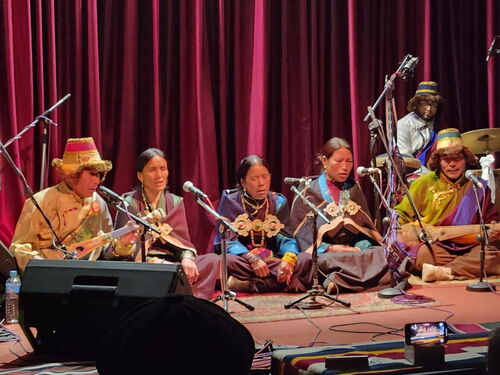
Pungmo Khung Lu - Ancient Chants from Pugmo Project
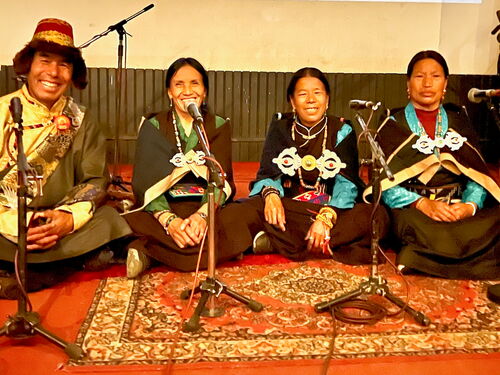
In Pugmo, there is a very old classical song repertoire that wonderfully sings about the traditional way of life, the harsh everyday life, nature, and pilgrimages. Through the initiative of Semduk Lama, the songs and their performance and dance styles were taught by the last remaining specialists to the next generation. Initial simple recordings were supplemented by a cooperation project with musicians from the Ethnomusicology Institute in Kathmandu. Together with local musicians, under the coordination of Semduk Lama and Eric Shresta, a musical exchange was realized, which the Tapriza Association was able to support alongside donors from Kathmandu thanks to a special donation. The highlight so far was a performance for the 100th birthday of the great Bön master Lopon Tenzing Namdak and another performance at Moksha Patan. The fundraising from this event as well as our support are intended to enable the recording, documentation, and archiving of this invaluable music.
Thangka Painting
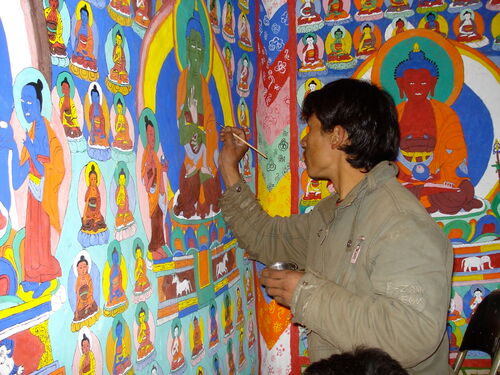
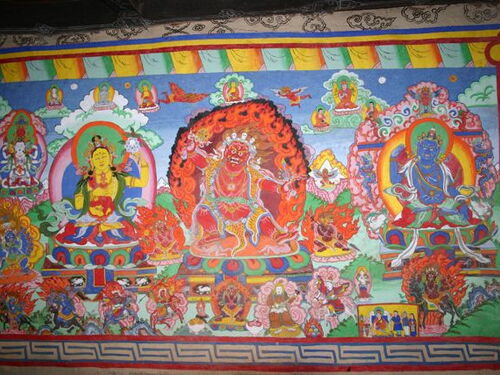
In the winter of 1999, courses in traditional Tibetan Thangka painting took place in Phoksundo and Kathmandu under the direction of the local master Yungdrung Yise Lama (also called Yungyel). The first course enabled eight young people – including a woman for the first time – to participate. Since then, the graduates of the course have been actively using their knowledge by restoring murals in monasteries (Gompas) and shrines (Chörtens) or by creating new Thangkas. To ensure the passing on of this craft despite Yungdrung Yise's failing eyesight, talented young people were sent to Kathmandu for further training. In the winter of 2006, Yeshi Sangmo, the first and top graduate, was able to successfully continue her training there. In the meantime, there are once again young Thangka painters from Dolpo who are actively working.
Woodcarving Art
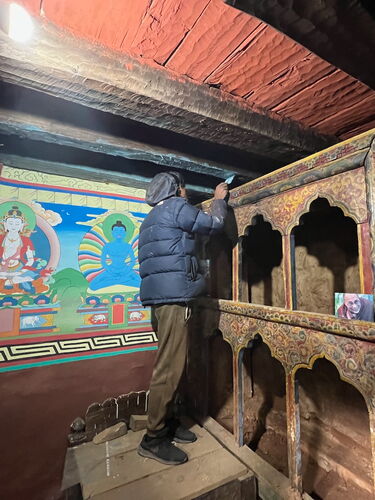
For years, a local master was responsible for both artistic and everyday woodcarvings, including pillars, altars, saddles, and figures of deities. Thanks to a scholarship in the winter of 2004/2005, his son, who already had experience in Thangka painting, was able to deepen his skills in a woodcarving workshop in Kathmandu. After his father's death, he took over his role and has since been responsible for traditional woodwork.
Carpet Weaving
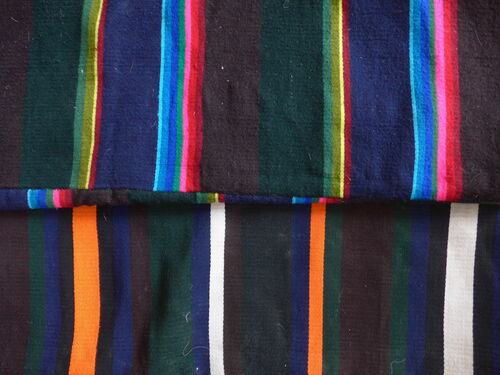
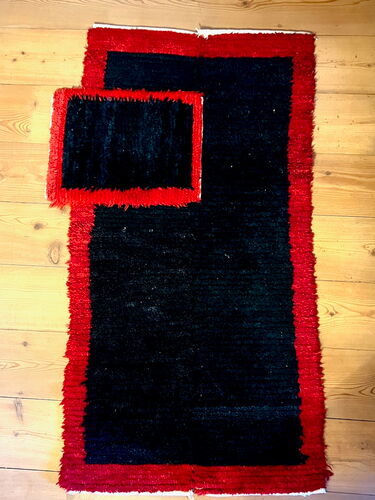
In 2003, we purchased 22 tool sets for carpet weaving training and gave them to the Ringmo and Pugmo "Sister Groups" (Didi-Bahini Samoa). The Pugmo group conducted a two-month training for 10 students. They learned quickly and were soon able to weave carpets themselves. Fortunately, Pasang and Pagtsan, two women from Pugmo, had already received training in Dunai, which was funded by WWF in 2001. This time they were able to pass on their knowledge to the others. The successful program was continued.
Sewing and Tailoring Courses
In the winter of 2003, the first tailoring course began, in which Monlam Baiji and Pasang Baiji from Pugmo learned to sew in Kathmandu and later produced school clothes for the Tapriza School free of charge. The training proved useful for the whole village, as what they had learned could be put directly into practice with a purchased sewing machine. In the following years, other women from Ringmo and Phoksundo were supported, so that some of the school uniforms are now made locally and tailor-made. In 2020, at the request of the population, we financed a tailoring course for the production of traditional Chubas (long coats, held together with woven belts, made of home-woven fabric).