Master Tapriza
The Bön Master Tapriza
The school is named after an important master of the central oral tradition from Zhang Zhung, a former kingdom in what is now western Tibet. Tapriza, or Tapihritsa (Wylie tib. Ta pi hri tsa), is the name of an 8th-century Bön master who refined his teachings during nine years of retreat on a mountain with ascetic practices. Thus he achieved the highest accomplishments and attained the rainbow body. In his next life, he became an important teacher and is now considered a central meditation figure in Bön practice and a role model for the Tapriza School. To simplify the pronunciation and to distinguish ourselves from the great Bön master, we named the school "Tapriza".
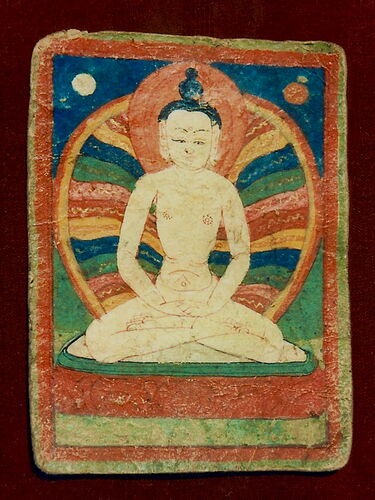
Through his religious practice, Tapriza (Tib. Ta-pi-hri-tsa) attained the rainbow body, enlightenment. The Bön religion was initially practiced in Dolpo by a few hermits who settled in remote valleys of Dolpo. In the 13th century, Yangton Gyaltsen Rinchen founded Samling, the first Bön monastery in northern Dolpo. Yangton Gyaltsen Rinchen is also a central representative of the oral transmission lineage from Zhang Zhung (Zhangzhung Nyangyü). Today, besides Samling, there are various Bön monasteries in the villages of Pugmo, Ringmo, Do-Tarap, Tsharka, Parlä, Hurikot, Tshalung, and Kalibon. The tradition practiced in Dolpo is called Yungdrung Bön, "The Everlasting Bön", and traces back to the founder Tonpa Shenrab Miwo.
He created a doctrine of faith for the development of well-being through the generation of wisdom and compassion, which is conveyed in the teachings of the "Four Portals and the Treasury" and the teachings of the "Nine Ways". The highest stage of meditation is Dzogchen, "The Great Perfection", in which the practitioner is introduced to the true nature of their mind. There are many parallels to Buddhism, especially to the Nyingmapa tradition, yet it is a distinct tradition whose roots are much older. Although historically there have been many disagreements between Bön and Buddhism, Bön is today referred to as the fifth school of Tibetan Buddhism and was recognized as such by the Dalai Lama in 1988. After the occupation of Tibet by China, Dolpo is one of the few regions where the Bön religion could be practiced continuously. (Description by Marietta Kind)
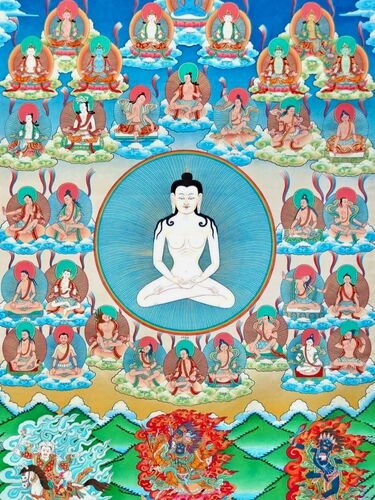
Description by the Thangka Artist Sonam
The historical Tapihritsa was born into a nomadic family in Zhang Zhung. Tapihritsa's main teacher was Dawa Gyaltsen. Tapihritsa practiced for nine years before attaining enlightenment. The place where he practiced is a sacred site outside Mount Kailash, a place called Senge Tap. After nine years of practice there, Tapihritsa attained the rainbow body (enlightenment). Tapihritsa was a contemporary of the King of Zhang Zhung, Ligmincha, and the King of Tibet, Trisong Detsen, as well as other famous Bön yogis.
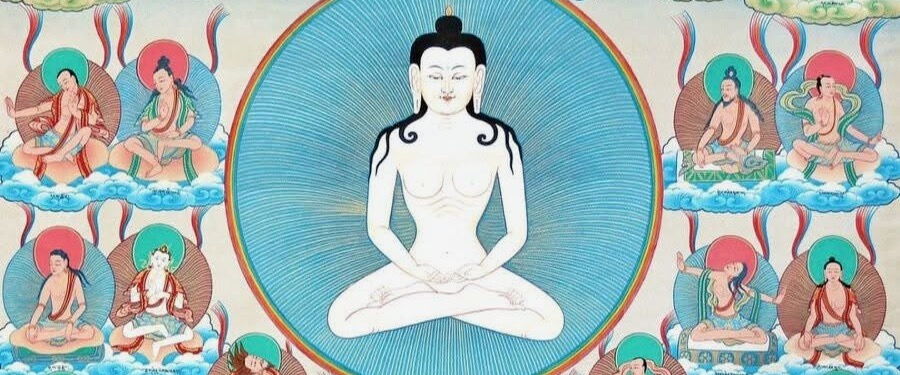
Tapihritsa is often visualized as the embodiment of the realization of all masters of the Zhang Zhung oral whispering transmission lineage (Wylie: zhang zhung snyan brgyud), one of the three Bön Dzogchen lineages. On the Thangka, Tapihritsa is seen surrounded by various masters of this transmission lineage.
Tapihritsa - described by Yongdzin Lopon Tenzin Namdak Rinpoche
The story of Tapihritsa, told by Yongdzin Tenzin Namdak Rinpoche during the summer retreat in 2000 and retold in English by Geshe Tenzin Wangyal Rinpoche. Tapihritsa was an ordinary person from a nomadic family in the land of Zhang Zhung. Tapihritsa's main teacher was Dawa Gyaltsen. Tapihritsa practiced for nine years before attaining enlightenment. The place where he practiced is a sacred site outside Mount Kailash, a place called Senge Tap. After nine years of practice there, Tapihritsa attained the rainbow body.
Tapihritsa was a contemporary of King Ligmincha of Zhang Zhung, and King Trisong Detsen of Tibet, as well as other famous Bön yogis. Nangzher Lopo was a very famous master, a knowledgeable and highly accomplished practitioner who was famous in Zhang Zhung at that time. Later he became the main disciple of Tapihritsa. Although Tapihritsa had previously been taught by Nangzher Lopo, Nangzher Lopo had a problem with pride and was not fully realized. Therefore, Tapihritsa manifested at that time as a young boy and came to the village where a rich man named Yungdrung Gyal lived, the main patron of Nangzher Lopo.
Tapihritsa appeared in the form of a boy looking for work in the family of Yungdrung Gyal. He served them for several years. Nangzher Lopo meditated on a mountain covered with bushes, and Tapihritsa took care of the family's animals. These places can be identified today in the western part of Tibet. When people visit these powerful places today, they have many impressions and visions. Some people who do not know the history of the place believe they are seeing ghosts or something similar.
Tapihritsa carried a lot of wood in his bag to cook food. He visited Nangzher Lopo to pay his respects. Nangzher Lopo hesitated when he saw the behavior of this young man. The way he paid his respects seemed special and mature, and he thought: "Who is this boy?" So Nangzher Lopo told the boy that it looked as if he had studied some teachings and principles. He asked him: "Who is your teacher and what is your practice? What are you carrying there? Why are you behaving like this?" The young boy said: "My teacher is this vision. Visions are my teachers. My practice is free from thoughts, my meditation is for all sentient beings. What I carry are my thoughts. I behave like this because I am a servant of the family of Samsara." When the young man answered like this, Nangzher Lopo was surprised, and they started a debate. Nangzher Lopo said: "If these visions are your masters, this probably means that you have no master; if your meditation is free of thoughts, you need no food; if you meditate on sentient beings, that means you are enlightened; if you carry thoughts, you have no desires; and if you are a servant of samsaric beings, you do not suffer!"
The boy answered again (and in this debate, the teachings have already begun). "If you do not realize that the vision is your master, then who taught Samantabhadra?" asked the boy. "My practice is thought-free, because in the base there are no thoughts, and if there is a thought, there is no practice. I meditate on all sentient beings because I do not distinguish or discriminate against others, because when one discriminates, there is no meditation. I carry thoughts within me. That means I have no thoughts. Because I have no thoughts, I also have no desires. I realize that everything is an illusion. I help all sentient beings because I make no difference between suffering and not suffering."
Then the debate continued. "If you are so good," said Nangzher Lopo, "we must go before the king and debate. If you win, you will become my master. If I win, you will be punished by the king." Tapihritsa laughed loudly. "All karma and all conditions, causes, and results are false." Basically, he teased Nangzher Lopo and said: "All these meditators are prisoners of their thoughts; they keep their thoughts imprisoned and are prison guards! All these intellectuals who debate do not realize that they are throwing a net into the darkness. All these discussions are like a joke and a game, a weapon of words. All sacred tantras are merely elaborations of one's own mind. All these knowing persons are meaningless - they know and have no experience." So he teased and said: "These great views are word bubbles - all these things are meaningless and make no sense. The true state cannot be changed. The true essence cannot be practiced. Self-arising wisdom cannot be clouded. If you realize the true nature of the essence, you cannot realize again or try to realize again. So what is the problem? Who is complaining?"
Now Nangzher Lopo became slightly irritated and realized that this was not just a simple boy, but a special person. He was shocked and could hardly speak. In this moment of shock and surprise, he looked at the boy, who was floating upright in open space, and that is how we draw him - in open space and in the rainbow. Nangzher Lopo was very sad when he realized how much bad karma he had created through his wrong view. He made prostrations and confessed his guilt, as he realized that the boy was a manifestation of his teacher. Then he asked for instruction. At that moment, Yungdrung Gyal, the owner of all the animals, came and saw this discussion. He said: "What are you doing here all this time? Where are all the animals?"
Then Nangzher Lopo, who knew Yungdrung Gyal very well, immediately said: "What bad karma we have created! You made the master a servant, and I said all these things to him!" Yungdrung Gyal was in shock. Such shocks are good. When you wake up, you are in a different place. So the young man floated up into the open space and said: "I am Tapihritsa and I came especially for you."
So that is the story. Then Tapihritsa began to teach Yungdrung Gyal and Nangzher Lopo. He said: "Listen carefully and do not be distracted." Both listened attentively. Do you understand now who Tapihritsa is? This is not just a story, it is a fact, it really happened. It happened in the seventh or eighth century. The teachings are "Dzogpa Chenpo", the "Great Perfection". The result is the rainbow body. There is no doubt about that. If you have doubts, that is your karma.
(Actually, Tapihritsa asked them to listen carefully, but at the same time he was speaking to all beings, and Lopon is saying that basically he is talking to all of you.)
Excerpt from the revised transcript of his oral teachings, translated into English by Geshe Tenzin Wangyal Rinpoche © 2005 Ligmincha Institute 7/27/05 Source: http://www.ligmincha.org/program/description/tapihritsa.html